What is a geometric pattern?
- A geometric pattern is a kind of pattern formed of geometric shapes and typically repeated like a wallpaper design.
- Any of the senses may directly observe patterns. But to observe abstract patterns in science, mathematics, or language, analysis is necessary.
- Patterns are created by symmetries of rotation and reflection
How to identify a pattern?
1.Repeats according to a specific rule


2.Turns 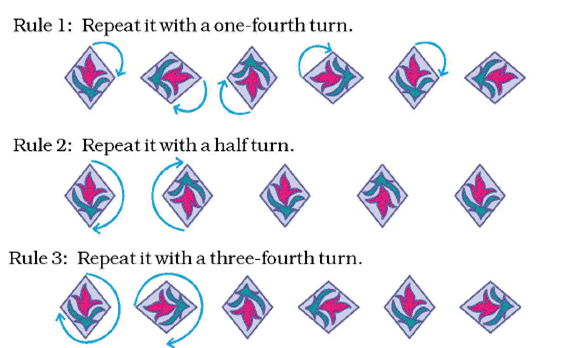
3. Rotation – clockwise / anticlockwise 

4.Rotation with respect to angle 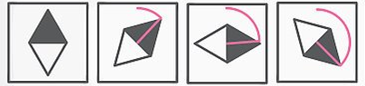
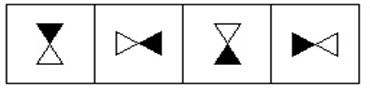
What is symmetry?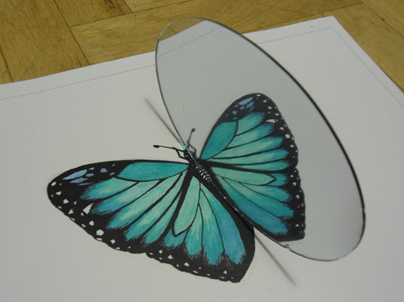
•Any object which is invariant under any of various transformations; including reflection, rotation or scaling is said to be symmetric
•Types of symmetry
i.An object has reflectional symmetry (line or mirror symmetry) if there is a line going through it which divides it into two pieces which are mirror images of each other.
ii.An object has rotational symmetry if the object can be rotated about a fixed point without changing the overall shape.
Line symmetry
•A figure has line symmetry if a line can be drawn dividing the figure into two identical parts and line is called a line of symmetry.
• Both the parts are mirror images of each other.
•The line of symmetry is also called the mirror line or axis of symmetry.
•Lines of symmetry can be vertical, horizontal or diagonal 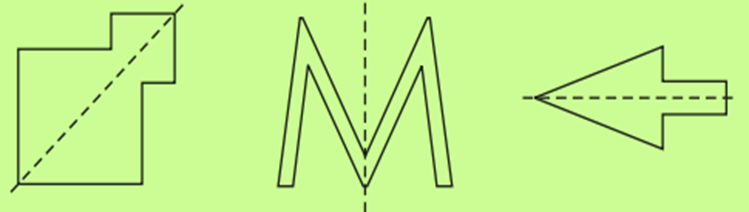
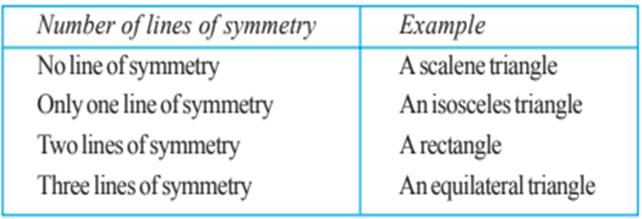
•A figure may have no line of symmetry, only one line of symmetry, two lines of symmetry or multiple lines of symmetry.
Here are some examples.
A circle has infinite lines of symmetry . 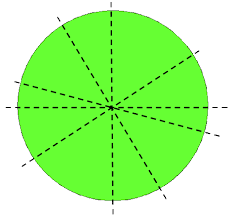
Lines of symmetry for regular polygons
•A polygon is a closed figure made of several line segments.
•A polygon is said to be regular if all its sides are of equal length and all its angles are of equal measure. 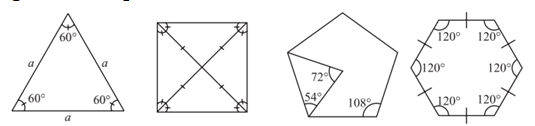
•Each regular polygon has as many lines of symmetry as it has sides 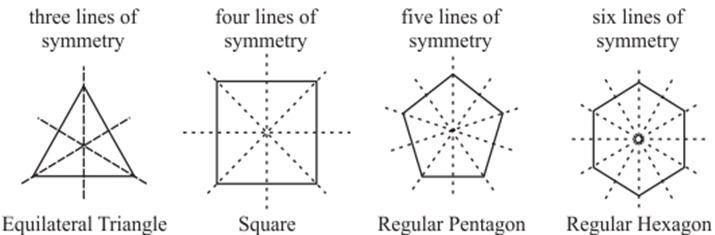
Rotational symmetry
•If, after a rotation, an object looks exactly the same, we say that it has a rotational symmetry.
•Rotation is to turn an object about a fixed point.
•This fixed point is the centre of rotation.
•The angle by which the object rotates is the angle of rotation.
•A quarter-turn is rotation by 90°; half-turn means rotation by 180°; complete turn is rotation by 360°
•The order of rotational symmetry of a geometric figure is the number of times you can rotate the geometric figure so that its looks exactly the same as the original figure.
EXAMPLE –
Square
(i) The centre of rotation is the centre of the square.
(ii) The angle of rotation is 90°.
(iii) The direction of rotation is clockwise.
(iv) The order of rotational symmetry is 4. 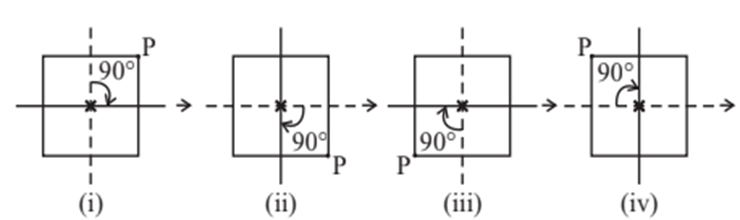
 LEARNING GEOMETRY